24 December 2015

Alternative Gifts


During this holiday season, and as 2015 comes to a close, many are searching for meaningful “alternative” gifts to give. While my expertise is in healthcare, let me suggest a few reputable organizations that are doing good in my hometown and around the world.

Austin

Hope Medical Clinic offers healthcare to political refugees settled in Austin through the United Nations’ resettlement program. Unfortunately, their initial health coverage in the form of Medicaid lasts only eight months. Then, most of these refugees from Bhutan, Nepal, and Iraq are left uninsured, yet needing the same preventive, chronic, women’s, physical therapy, and dental care that we all need. Hope runs purely on volunteer support and is a way to help refugees here in our own backyard.

The Austin PrEP Access Project evaluates patients for Truvada, to be taken as Pre-Exposure Prophylaxis against HIV. High-risk patients are evaluated by volunteer medical providers and monitored through regular blood draws funded by private donors. PrEP has proven wildly successfulin lowering HIV incidence in San Francisco, saving lives and saving costs for the local community.

Global

Samaritan’s Purse through its World Medical Mission funds short-term medical missionaries in settings requesting assistance around the world. This faith-based organization places physicians, dentists, and other personnel and supplies into resource-poor settings. I will be teaching as volunteer faculty at PCEA Chogoria Hospital’s new Family Medicine residency program through Kabarak University from February through June 2016. Samaritan’s Purse’s World Medical Mission is assisting in coordinating my documentation, travel, and funding. Follow this link, search for my name, and be assured your tax-deductible funds will go to essentials such as travel, food, visas, and my Kenyan medical license.

Medic to Medic funds education for physicians in low-income areas. The US has 2.5 physicians per 1,000 people; Malawi has less than 0.1 physicians per 1,000. This is a sustainable way to fund the education of health workers where they are needed most. You could fund a medical student’s tuition and all supplies for just $750 per year. A close UK-based physician friend of mine is an organizational leader.

SEED Global Health is a public-private partnership with the US Peace Corps designed to place American physicians and nurses in medical/nursing school and residency training settings as faculty to assist in educating physicians, nurses, and clinical officers in low-income countries. Being a uniquely American NGO, this organization funds some educational debt repayment for each year of service. I will be teaching with SEED from July 2016 through June 2017.

In my opinion, these three global options all represent sustainable steps towards universal health coverage in some of the poorest areas on the globe. Please join me in supporting these servant organizations. Have a wonderful holiday season and a Happy New Year!

26 October 2014

A World of Difference


“You should try the cheese and chocolate,” she said. “Cheese and chocolate?!” A confused facial expression accompanied my response. The local Stone Town woman smiled warmly under her ornate hijab and instilled confidence in this Zanzibar pizza chef – she was a regular. I couldn’t decide between the savory tomato, meat, and cheese or the sweet nutella, chocolate, and banana. She’d made my decision for me. “Don’t worry,” she said as she walked off with her pizza in hand, “you’ll try it anyway - this one’s on me.”

--

The first few times I traveled in sub-Saharan Africa, it was only natural to be confronted with how different this was from my world. There were people living in conditions like I’d never seen, receiving healthcare in clinics and hospitals considered substandard in Texas, and those with cultural practices and beliefs that seemed so odd. I was confronted with these differences each day, smelling the air, hearing the sounds, feeling the heat, stomaching the tastes. But following a more prolonged stay, becoming more comfortable with the setting, and after wading past the differences, I’ve started to appreciate all of the similarities. Why is the focus so frequently on our differences?

In American politics, we focus on what distinguishes one candidate from another, bringing us to the polarized place in which we find ourselves. In religion, one hears the call to prayer and sees the dress and thinks about the divergence of Muslims from Christians. In healthcare, physicians are trained to observe or judge patients based on differences in culture, gender, generation, or sexual preferences. And in current events, the media highlights the many challenges our dissimilarities have brought us. Perhaps if our global village started to focus on our similarities, our mutual reliance on a healthy economy and environment, and our collective desire for basic necessities, we would avoid much of the needless conflict we see ourselves in today.

When Ebola first set foot in the U.S., we were already 8 months and about 4,000 cases into the current epidemic. It was already 10 times larger than any prior Ebola outbreak. And then the West took notice. We were different from Liberians, until we were in the same boat. Ebola was a world away, until prevalent international travel put us on the same globe. Then we started a furious search for a drug or a vaccine. Lower resource countries don’t have the market power to create the demand to inspire solutions to many tropical diseases. Instead we wait for vocal advocates such as Bill Gates, Bill Clinton, or Margaret Chan to push donors into these arenas to find an answer.

The silver lining of this experience with Ebola ought to be a resurgence of civil debate on how we spend our abundant resources, with renewed focus on the societal good.

The last two weeks I spent learning predominantly about Palliative Care and HIV/AIDS care in Uganda. Our week at Hospice Africa Uganda involved learning about the expansion of oral liquid morphine access for pain control in terminally ill patients, followed by home visits to those receiving home hospice services. Our home visits involved two women dying of cervical cancer, dealing with pelvic pain and urinary incontinence. They simply wanted pain relief and urinary care to die with dignity and in peace. Much like patients in the U.S. 


These patients many times get confused by difficult drug regimens, despite only having ibuprofen and morphine for pain control. Primary care doctors, nurses, and clinical officers at times are not trained to refer to Palliative Care at the appropriate time. There is also a shortage in these providers to competently prescribe this powerful drug, which lowers the amount of patients who can benefit from it. And Hospice Africa Uganda is on the brink of a severe funding shortage, with 70% of their funding coming from external donors, much of that being cut in the near future, leaving inadequate funding from the government to keep the service up and running as it is now. They are the only producer of oral liquid morphine for all of Uganda. All of this – poor funding, health worker shortages, patient education challenges – we deal with in the U.S.

The HIV/AIDS epidemic is showing signs of improvement. The number of new cases each year is dipping, but due to a lack of functioning health facilities and a severe shortage of health workers, many are still diagnosed late, dying of largely preventable causes. Mulago Hospital, the national referral hospital for Uganda is overcrowded and under-staffed, but still the best place to handle complex cases. There, we rounded on patients with advanced lymphoma, visceral leishmaniasis, advanced lung cancer, and toxoplasmosis. The chemotherapy or proper treatment is largely unavailable or too expensive, and thus these patients rely on family to take them home and care for them, without the help of the public health system. Despite seeing this for a couple months now, it doesn’t make it easier. In the U.S., we too still have many without basic health insurance and poor access to primary care services, thus they present late in their disease, which can lead to worse morbidity or even mortality, and is more costly on society.


When I return home from traveling and studying this time, I’m sure I’ll be asked about the differences. But in addition to telling of these, I plan to speak of the many similarities, and how we are in this together. Whether we plan to bring the current Ebola outbreak to an end, or to control tropical ailments with basic public health efforts, or plan to alleviate poverty in any setting, it may just be in our interest to focus on how similar we are, rather than taking the easier route of considering us all so different.

--


My cheese and chocolate pizza was ready around the time my friends caught up to me circulating the nighttime food market on the water’s edge. We each tried a bite and she was right - it was a hit. So we ordered three more to finish off our dinner.

09 October 2014

Morning

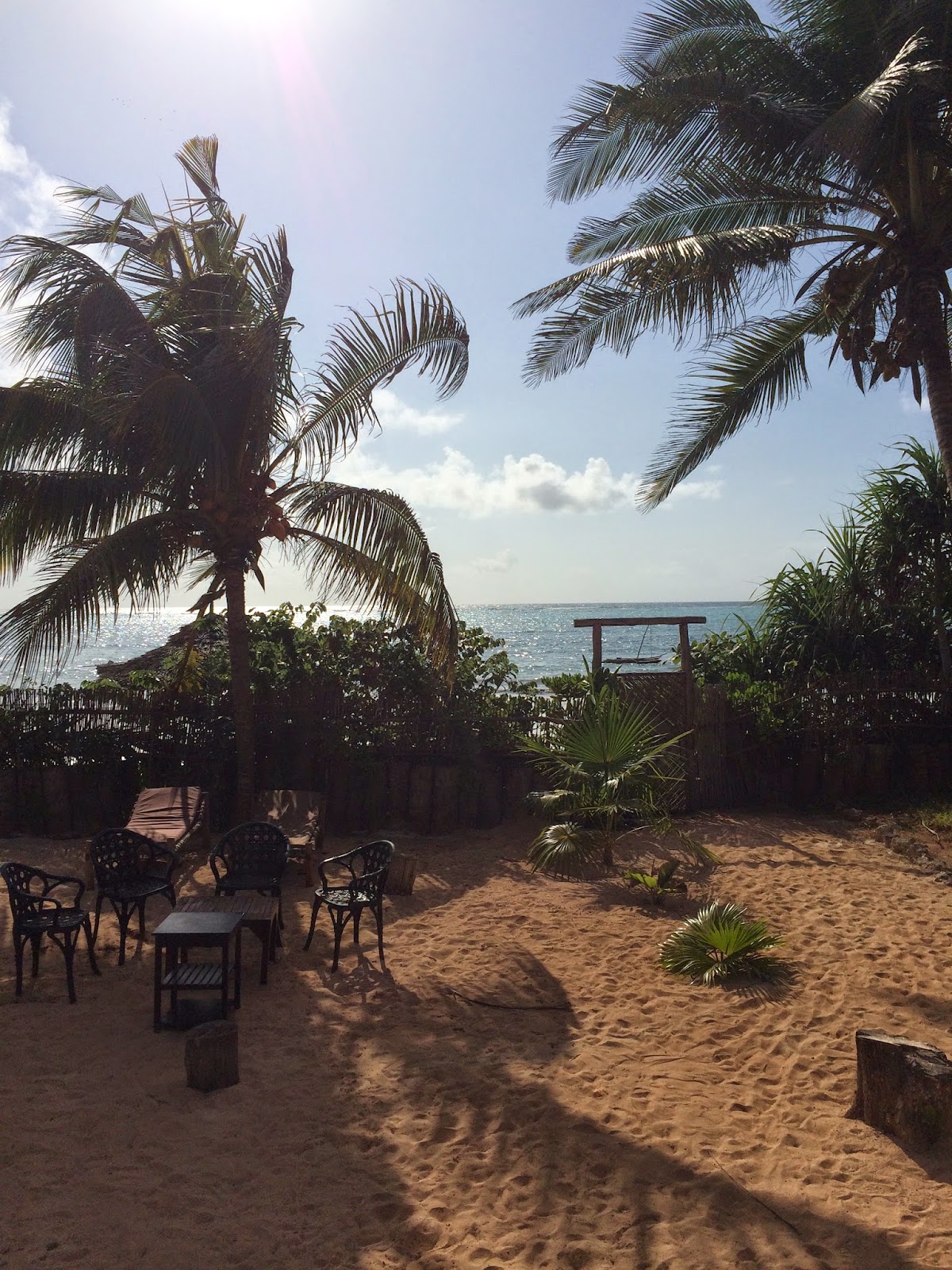
Morning view for coffee and Al Jazeera, WSJ, and Health Affairs reading.


16 September 2014

Pemba!

The aroma of Zanzibar spices and fresh vegetables is filling our dining area as May prepares our curry meal for dinner. She’s one of my classmates from Australia who has, through her offer to cook dinner, become even more popular this evening – each of us has peeked into the kitchen one-by-one to half-sincerely offer to help, but more so to check in to ensure our spot at her dinner table. Tonight is the first night we have had a long rain, providing a calm evening for our hostel to dine together and catch up.

----

Malaria was the major theme of the second week. Our main professor practiced as an Infectious Disease physician and studied Malaria for over four decades. He retired just three weeks prior to joining us for his week of lectures. Most fascinating, he was part of studying the malaria vaccine. It was particularly eye opening to hear him, the academic, the expert, point first to the importance of access to basic healthcare, existing medicines, and public health infrastructure, before more advanced studies on new treatments or vaccines that are either too expensive to be rolled out any time soon or not even very effective.

The middle of the week, instead of exploring three cases in-depth, we rounded rapid fire on about 8 cases within 2 hours.  Case 1: Tuberculosis. Poorly treated the first time, and concern for a multi-drug resistant case, perhaps with an overlying cancer. Case 2: Lymphoma, but we could not investigate further due to lack of pathologist. And even then, there is no access to even basic chemotherapy here at this regional referral hospital. Or an Oncologist. Case 3: Acute onset lower extremity neuropathic symptoms. No MRI machine. No X-rays completed yet due to cost.

You get the idea. It can be gut-wrenching and it’s simply not fair.

----

Today was a full day of presentations, hearing about each small group’s one-week (week 3) rural placement. One group studied palliative care and end-of-life beliefs amongst Maasai villagers, another studied malaria rapid diagnostic test use amongst physicians and traditional healers, and another focused on battling malnutrition.

My group traveled to Pemba, the northern of the two major islands that make up Zanzibar. We spent the opening weekend at the apparently infamous “Biederman’s Farm.” The farm excursion was a 2.5-hour bumpy dirt ride from Tanga, and came with fresh cold milk and cheese that we think was properly pasteurized. Mr. Biederman has lived there for 50 years, following an initial placement on the Tanzanian coast by his engineering firm. His property is dotted with barrels of mosquito larva-eating fish that Dr. Albert Schweitzer reportedly introduced to him (?) and swore by as protection from malaria. We spent hours swimming in the incredible warm water of the Indian Ocean, where the stressors of real life back home finally washed away. Some take a few days to really relax on vacation; I took about 12 days to be fully on board here.


The following day we flew to Pemba on a 14-seat plane. A couple cold beers at the airport treated the pre-flight anxiety. The safety demonstration was two sentences. The 20-minute flight ended safely and we were eventually delivered to our destination – the Public Health Laboratory (PHL) guesthouse. Zanzibar is largely Islamic as evidenced by the more conservatively dressed women and the 0445 calls to prayer.


The PHL was originally started by an Italian NGO but is now well integrated into the Zanzibar Ministry of Health (MOH) and its public health campaigns. Zanzibar is actually its own “country,” depending on who you speak to, and is part of the United Republic of Tanzania, but its Ministry of Health functions autonomously.

Health spending in Zanzibar reaches $13 per person per year, versus $3600 and $8600 in the UK and US respectively. Stop and think about that. I didn’t accidentally add or omit zeros.

Our hosts provided lectures on schistosomiasis, water quality, the Zanzibar health system structure, and sanitation, and then we set out on field trips to see some water quality measurements and latrine construction in action. In the evening, we ate our home-cooked meal, played Mafia, and watched the British TV favorites of The Inbetweeners and Fawlty Towers. I had forgotten about Mafia, played when I was younger, but when 11 physicians from different countries are put in a dry guesthouse with little else nearby to do, Mafia proves quite entertaining.


Thursday evening ended with a lavish thank you dinner for our hosts at a nice hotel. We mixed with another group of consultants and funders in town from the UK and US here to assess the Millennium Village on Pemba. Our hosts were actually key leaders in the implementation of the village, selected as one of the poorest in the world. Some of our hosts sat at the consultant table for political purposes while others chose to sit with us to avoid the formal chat. 2015 will be the final year of the Millennium Villages Project and it is when the Millennium Development Goals will essentially “expire.” The Pemba village appears to be on track and the funders seemed pleased with the results in this penultimate year.

And then came Friday night. Friday we flew another short flight across to Unguja (the main island of Zanzibar) to join forces with two of the other small groups. After completing our write up of our project on shistosomiasis, and traveling hours longer than expected, we arrived after dark at the guesthouses on the beach of northeast Unguja. We threw down our bags and walked 10 minutes down the beach to join the others at happy hour – and you would have thought we were heroes returned from battle! Clapping, hugs, kisses, high-fives! I think we surprised ourselves by how happy we all were to be reunited.

It has always struck me how quickly people can become close and build relationships. During times of stress, people seem to need each other. And when the group starts off with baseline commonalities, they start from an advanced position due to an existing high level of trust. Fraternity pledgeship. Residency training. Summer camp. Whatever the experience, it’s a powerful pull that is difficult to put into words and it’s exhilarating to be in the middle of it.


We spent the final night on the beach taking in the clear view of the stars and rising moon celebrating our classmate’s birthday. After blowing out her candles on the dry chocolate birthday cake, she wondered aloud: “I wondered today if this might be the best birthday I’ve ever had. And I think it is.”

----


Dinner is ready. Thankfully, I’ve contributed some wine and a chocolate bar for dessert.

31 August 2014

From the base of Kilimanjaro


Energized by the 2.5-hour church service at the Anglican Church here in Moshi this morning, I figured it was time to check in. I arrived in Moshi (Tanzania) last weekend, but my delayed checked bag stayed behind a few nights in Nairobi at the international airport. Following some local advocacy by our course administrator, a handful of patient phone calls to London, Nairobi, and Dar es Salaam, and a few clean shirt changes thanks to our course director, my bag arrived at Kilimanjaro International Airport for pick-up Tuesday evening.

We are now one week into the East African Diploma inTropical Medicine and Hygiene put on by the London School of Hygiene andTropical Medicine (LSHTM). 58 physicians are attending the three-month course. Roughly one-third are from the UK, 8 are from Australia, and the rest represent places such as Ireland, Botswana, Scotland, Austria, Denmark, Canada, Portugal, Uganda, Tanzania, with yours truly being the sole American representative.

Our course began Monday morning with brief introductions, registration, the passing out of our heavy textbook, Principles of Medicine in Africa, distribution of some bicycle helmets (in case we decide to hop on the back of a motorcycle as transportation instead of a taxi), and safety warnings. The first week focused on Epidemiology, where we reviewed the basics of epidemiological study design, had a review of biostatistics, and went in depth into the original outbreak of Ebola in the DRC. A timely topic, we thought... Our lecturer was a well-known epidemiologist and Infectious Disease (ID) specialist from LSHTM. She made a potentially dry topic interesting, and is (like many of our lecturers), an author of chapters in our reference textbook.


The mornings were spent in lecture, and the afternoons were spent in group Swahili lessons and clinical rounds. I rounded at Kilimanjaro Christian Medical Center (KCMC, our home-base in Moshi), with our small group of seven. Our Attending was an ID specialist from Cape Town who conducted bedside rounds. First, we saw a case of an HIV-positive woman with a Co-trimoxazole (Bactrim) induced dermatologic drug reaction. Unfortunately this could have been avoided as at the time she started the medication for PCP prophylaxis, it was not yet indicated. Our second patient was battling chronic schistosomiasis with resulting splenomegaly and esophageal varices. These patients end up severely anemic from GI bleeds and have a fairly poor prognosis. Lastly, we saw a patient with a history of TB, currently struggling with an exacerbation of chronic interstitial lung disease from his years of work in the tanzanite mines. My second day of rounds, we went off site to a smaller district hospital, where we saw four pediatric patients with viral gastroenteritis, rickets, tonsillitis and severe malaria respectively. Our Attending this day, was a local Moshi-based physician who claims he has an allergic reaction any time he travels too far out of the Moshi area.


In these settings, there is very limited access to laboratory tests or imaging, so most of our diagnosis was based on clinical examination and physical signs. Even though this is a tertiary referral hospital, there is no pathologist on site most of the year to read biopsies. There is a CT scanner, but it has been broken for three years. The machine to do a complete blood count is broken – and there is no back-up. These local Attendings are unbelievably impressive with what they can deduce from just a physical exam, whereas in the States we have come to rely on more costly measures to nail down a diagnosis in nearly every case.

Socially, or what our course director affectionately calls the “Hidden Curriculum,” things are ticking along quite nicely. Most of my classmates are in the middle of their specialty training and many have a wide variety of experience. A common thread however, is that they have almost all had an “elective” experience working in a developing area, and are currently taking, or have already taken, a year off in the middle of their post-graduate training to travel and learn more about healthcare in different settings. That’s in stark contrast to American docs who are in such a hurry to complete residency training for a variety of reasons. More on that later. I have enjoyed getting to know my classmates and lecturers, slowly adding in one or two at a time, hearing about their travels, their training, and their feelings on the system within which they work.

Our lodging is decent, and Thursday night we had a meal cooked at our hostel (our group is staying in one of four places around town) for $5 per person. A few from the other hostels came by, and half the group hung around on my hostel’s terrace ("Terrace Thursdays" we've dubbed it) for a few Kilimanjaros (beer) and some Konyagi (the local spirit). 


Most of the group went on safari or to stay a night at the Ngorongoro crater this weekend, but Micah, my new Irish friend, and I went out to Honey Badger Lodge for some relaxation poolside. An Epidemiology professor associated with the LSHTM based here in Moshi owns the Lodge.


We are now preparing our reading for next week’s topic – Malaria. The end of next week we will travel in six small groups to our one-week rural placements to learn about different community-level health services or projects. I’ll be headed out to Pemba, the northern island of the Zanzibar region, and most of us are eagerly anticipating the week away.


The first week was busy, but it is about to end with our hostel’s cook serving a homemade meal. What a blessing to be here – when your Sunday evening sunset looks like this, it’s easy to be reassured you are exactly where you should be.


22 August 2014

Kwaherini!

4 months. 1 bag.

21 April 2013

In Defense of Backpacking: Is free WiFi killing the backpacking experience?


“So where y’all from?”  That one simple phrase is the only thing necessary to spark an instant friendship under the hostel roof.  Backpackers share many of the same traits – the spirit for adventure, a desire to see new parts of the world, simple travel needs, being trusting enough to share quarters with complete strangers, and the goal to do so in a cost conscious manner.  Sharing a bathroom with a friend or a sibling is hard enough for most.  Sharing a bathroom with someone who doesn’t speak your language is a completely different experience. 

After a couple solo trips around the end of my time at university, there were so many elements of backpacking to which I’d become addicted.  Traveling solo had a certain air of freedom that, combined with cheap hostel rates, allowed for versatile travel plans.  Thus far, my whole life had been meticulously planned from my educational and career path to my tennis training.  Traveling with only my backpack was freeing, and began my desire for a new plan to have no plan.


Arriving at the hostel dorm is the best part.  After a brief check-in, I throw my bag on my assigned bed and start introducing myself around.  “So, where y’all from?”  In the hostel, we are all on the same team – traveling solo or in small groups, far from home, eager to explore, and celebrating life on a budget.  You know that you and your dorm-mates already have many things in common, so after the simple “where y’all from?” you can skip right to “what’s the plan for tonight?!”

The common area of the hostel is a place for sharing a cheap beer in the evening, hearing stories from the day’s sightseeing, and formulating the plan for dinner and dancing that night.   


“So, where you from?”  To be able to get this icebreaker off your lips, there must be someone ready to receive it.  This takes eye contact.  The hostel of 2013 however has unintentionally put a barrier in place to prevent this:  Free WiFi. 

Is WiFi killing the backpacking experience?  And is it eroding the ability for people to interact in the simplest yet most meaningful way possible - face-to-face conversation? 

Last month, I stayed in a giant hostel in Budapest I affectionately called the Disney World of hostels.  They’d literally thought of everything.  It was clearly built by backpackers.  The entire hostel was cleaned twice daily.  A hot breakfast was included.  They even had a small shelf on the wall near the head of each bunk bed with an outlet to set down your watch and charge your phone!  Most importantly there was a bar downstairs that was lively every evening complete with a pool table, Palinka tastings, beer deals, and a free drink on the evening you checked in.  I also stayed in a hostel in Istanbul a few days later that was a dump comparatively, yet still sufficient.  And both places had the same thing in common:  Free WiFi.  Both places I dropped my bag down, settled in, and came down to the lobby to find my new hostel-mates in the lobby glued to their iPads and iPhones, ear buds in.  There was even one Australian Face-timing loudly with someone back home on his laptop.  No one looked up to acknowledge their new arrival – me.  So I sat, opened my bottle of wine, read my book and hung out.  Everyone else read news, sifted through Facebook posts, and listened to music from their devices - everything they could have done back home.  They were so focused on their electronic task that there was no looking up to appreciate the current moment, take in the scenery, or make a new friend.

Rewind 9 years.  It’s 2003 and I’m backpacking for the first time ever, in Fiji.  I stayed in hostels in the Colo-i-Suva National Park and on Beachcomber Island, the latter a backpacker’s paradise where the dorm had 100 bunk beds under one roof, wide open to the ocean breeze entering freely on all sides.  Each evening after exploring during the day, I’d clean up in the dorm and go settle in the lobby or main bar area for a drink, and I’d do the only thing left to do – meet the rest of the folks staying there for the night.  There was no WiFi.  Both of these places didn’t even have Internet access.  Placing a call back home required a pre-paid calling card.  Thus, there were numerous steps (read barriers) necessary to connect back to the “real world.”  Instead I was forced to participate in the present.  Thank God for that.  I met two generous Swedish couples.  I watched some rowdy South Africans fail miserably at limbo.  And I took in one of the best evenings of my life – a Christmas Eve complete with free boxed Chardonnay and a game of musical chairs with 11 strangers. 


Six months later I found myself hopping through Europe over 5 weeks.  I visited with friends I met in Fiji and crashed in hostels when I was without a host.  To use Internet then I could walk to the Internet café, but that cost me a few Euros, which was a tough decision when that could have been put towards a cold beer instead.  The fact that energy was required to go find an Internet café was a barrier to my decision to connect and I only e-mailed my family and friends as much as was essential to let them know I was alive and well.  I was aware of my surroundings.  And my blessings.  And I was immersed in the moment.

Now we find ourselves in the age of 24-hour news outlets and second-by-second Twitter updates.  We in the States have slowly become comfortable with constant stimulation, whether that is by TV, music, Facebook, or text messaging, and we almost can’t live without it.  I see so much anxiety and attention deficit disorder and I have to think our constant need for connectedness, and our inability to occasionally “check out” from the stressors of daily life, is playing a role in this.  For if you are used to constant visual or auditory stimulation and then all of a sudden you have none, and are stuck with a still view of the ocean or find yourself seated in a somewhat quiet lobby or restaurant or bar, what would your natural reflex be?  To worry?  To reach back for your standard level of stimulation?

This is precisely why I am choosing to make a concerted effort to resist the new norm.  And, at the risk of sounding like (or posing as) a backpacking elder, I am calling all backpackers to do the same.  Whether you’re away for a year or a week, old or young, beginner or veteran, let’s return backpacking to its roots and keep the spirit alive.  Do it for your health, or your sanity.  But most importantly, do it in the spirit of building new connections around the world.

My home life is very well planned, with a fairly steady routine that relies greatly on the Internet and electronics.  But when I travel, I travel to get away.  To escape my daily routine.  To experience something new and meet new people.  To rest my brain, take a deep breath, pray, and reflect on how blessed I am and my current position in life. 

If I am constantly being told what’s happening on my iPhone I fear I won’t be able to see for myself what is going on right in front of me.  So it takes a conscious effort to stay off the iPhone, put it deep away in my bag and only use it for essential communication.  But it’s going to take a community effort to renew our vows to each other to travel for the original reason we were intrigued by the journey in the first place.  Perhaps you wanted to take in a kava ceremony in Fiji.  Maybe you wanted to reach the top of the Eiffel Tower.  You likely wanted to meet someone from a different culture and hopefully share a meal with your new mate.  Maybe this is another vacation away from your daily work or a necessary venture far from your comfort zone.  Whatever your inspiration for crossing international borders or flying across oceans, your iPhone or iPad will not be necessary for you to accomplish your end goal.  And they’ll be waiting for you back home – trust me.

So, disconnect.  Turn off.  Be present and soak in the moment.  And the next evening you’re in the hostel lobby or bar, decline the free WiFi and look up.  Our eyes will be able to meet and my friendly Texan face will be smiling to greet you: 

“So, where you from?”  And we’re already friends.