29 March 2016

Meeting Joe Black

The timeliness of watching Meet Joe Black early in the Easter week experienced here in Chogoria became apparent only late Sunday evening. Joe Black, played by a young frosty-tipped Brad Pitt, is perhaps the most attractive physical embodiment of Death ever created. He comes to get a taste of life the best way possible: alongside wealthy media mogul Bill Parrish (Anthony Hopkins) who is approaching the celebration of his 65th, and apparently last, year. A bit naïve to the daily jargon of life, Mr. Black at one point interrupts a board meeting of Parrish’s company when a board member mentions the certainty of death and taxes. “Death and taxes?” he asks, appearing confused and offended.

This week, the inevitability of physical death and the promise of life beyond death were juxtaposed in a way that leaves one pondering most proximately what awaits the deceased after life’s most final event.

--

The transition from old class of Medical Officer (MO) Interns to new class of MOIs came rapidly. Highlighted by wrapping up Advanced Cardiac Life Support (ACLS) training and a pot-luck goat roast funded by the hospital Wednesday night complete with speeches from much of the medical staff, the outgoing MOIs were done with their Intern year and headed out to work in various posts around the country. The new MOIs were now on their own, running each of the inpatient services and independently taking care of patients in the outpatient clinic.

The week after their ACLS training, a new MOI and one of our residents led a resuscitative success with a young poorly controlled hypertensive patient. She was shocked once and after some chest compressions and correcting her potassium level, she was alive. Depending on the etiology, resuscitations commonly end with death. And this past week saw a couple of attempts to revive extremely sick patients that ended poorly.


We showed up for rounds Thursday morning to find one of the two MOIs on our service missing. She had gone for a break after spending four of the early morning hours attempting to resuscitate, and eventually losing, two newly admitted patients. One transferred from another hospital down the road, another with severe lower gastrointestinal bleeding. Neither lived to be seen by our staff in the morning. The fellow MOI covered for his teammate. “She is not in a good emotional state, so she went to the house.” I was glad the MOI had made the wise decision to take a break to regroup after a rough morning.

She returned an hour later. No matter how she felt, a busy medical ward needed to be cared for and she was their primary physician. The last couple weeks our ward has had many interesting guests including the rare case of malaria, some brittle diabetics, an older man celebrating his discharge on the same day as his neighbor’s (“The two old men are going home!”), and the police officer who was visited on the ward by his four colleagues wielding a baton, an automatic rifle, and a newspaper.

Towards the end of rounds, the five-member family of our latest death appeared requesting to speak with the MOI. The head sister (nurse) in charge on the ward motioned for me to accompany her and the MOI in the discussion.

What do you say to someone who has had a family member recently pass away? What if you were the one entrusted with keeping them alive?

Many family members here in our area drop off their family members toward the end of life when they sense they cannot provide proper care for their loved one. We then do our best to control their pain and keep them comfortable, managing complications of advancing cancerous masses, bladder obstructions, severe systemic infections, and decreased oral intake. There is no Do-Not-Resuscitate (DNR) order here, so the attempts to revive, and their extent, are decided many times unilaterally by the MOI on call.

The MOI conducted the family meeting in a mixture of Kiswahili and English. She explained in detail the state in which the patient came in, the resuscitation attempt including who was present and what was achieved, and eventually when the elderly gentleman died. The nurse answered practical questions about morgue costs and how they could pay the hospital bill when they eventually took the patient for burial. The patient’s daughter knew death was imminent, she said. “I just didn’t think it would be this morning.” They thanked us and went to view their patriarch one last time.

The MOI admitted afterwards that she had never broken the news of a death to a family. So we debriefed, talking mostly about what she had done well and then what she could improve on for the next time. Remain objective, but show empathy. Discuss details in plain language, but only as much to be complete and adequately informative. Was my approach molded within the American system appropriate for this community? My MOI and I came to a few conclusions. Discussing death is never easy and always different depending on the circumstances and the family.


Then came Easter Sunday. We started with a service here at our campus Presbyterian 9 a.m. English service followed by a group lunch with a few missionary families. It was another beautiful day full of good food and an Easter egg hunt. But the resident was late.


He was called in to assist with the deteriorating patient we had dealt with for a week-and-half. She had just given birth to a healthy baby three weeks prior. Originally diagnosed 10 days ago as septic shock due to her low blood pressures and spiking fevers, a poor condition due to wide-spread infection, and treated with intravenous hydration and several powerful antibiotics, she was not improving. Further investigation with a bedside echocardiogram revealed a heart that was almost not contracting at all and a massive blood clot left by the stagnant blood in her left ventricle. Postpartum, or peripartum, cardiomyopathy was the new diagnosis and we prepared to transfer her to a higher level of care. Our hospital is usually the referral hospital for several smaller facilities nearby, but now we needed help. Before she could be transferred however, she passed away early Sunday afternoon. Her three-week-old infant laid wrapped on the nearby twin bed in the private room with grandmother sitting next to the baby.

--

No matter how inevitable, no matter the medical training in objectivity, death hurts. Seeing a death that leaves a healthy three-week-old without her mother begs the obvious question of “Why?”

Following the death of a patient, the discussion many times revolves around justifying both to ourselves and the family that we did “everything we could.” But had we in these cases? Did we have sufficient knowledge, medications, specialists, technology to “do everything?” No way. Had she given birth in my hometown of Austin, her chances of survival would have greatly increased. We could take comfort in knowing we did all that was possible within the constraints of our local system. But considering all the resources available on this planet, we had not truly “done everything.”

Life is precious and perhaps work in medicine offers a close-up yet lopsided view of just how quickly life can change.

Following the grand birthday celebration at the end of the movie and after Parrish has accepted his long, fulfilling life is over, Joe Black and Bill Parrish disappear over the bridge to his death. How peaceful. That romantic depiction of life and its end can occasionally be disrupted. Shaken by a lack of control and confronted with physical death, there must be something beyond that bridge, beyond the mother leaving her infant, that offers hope.

There is so much we can affect in modern medicine, but sometimes death comes. I choose to think Death came as Brad Pitt here in Chogoria. Perhaps I was just too blinded by the circumstances to even see him.


Sunset over Lake Victoria

08 March 2016

"Nice Times"

It was blazing hot. The ice in my drink made the cup sweat. I looked up across the horizon. Blue salt water ahead with the pool in my periphery. This was the life.

Just then, the front my head started to pound. I looked up at the pots of dinner being served on the Maasai-cloth-covered picnic table in our hut. I was wearing all the clothes in my bag and it was only the first night of our three-day climb up Mount Kenya. It was actually near freezing. And this city boy from Texas was ill prepared, clutching the one-liter thick plastic water bottle of recently boiled water. The views were incredible and the company of our six-trekker group assembled by the doctor from New Zealand made the hikes pass quickly. But the cold nighttime weather in a setting slightly outside of my comfort zone had me daydreaming.

I have been guilty of daydreaming before. I’ve even been called out by good friends when they have caught me distracted. So in this first month away, I have been extra careful to consciously ensure I’m present. “In the moment,” some call it. But I am not convinced that is always so easy, or absolutely necessary.


--

The excursion to Mt. Kenya was something I had considered prior to coming to Chogoria, so when the group effort had already been coordinated, I decided to take my first trip out of town. We traveled by matatu to Tumutumu to be hosted the night before by a young Pediatrician and her husband from the UK. They fueled us up with chapati and vegetables before the climb. The following morning, we had a proper cappuccino en route to stock up on snacks at the Nakumatt supermarket in Nanyuki before entering the park. It is a beautiful but challenging climb, with the second day requiring an 8-hour, 10-mile, steadily uphill trek. That day left me feeling lousy (perhaps with a bit of the 13,000-foot altitude contributing) at base camp, so I decided against summiting the next morning. Many say Mt. Kenya is tougher than Mt. Kilimanjaro and I now know why.

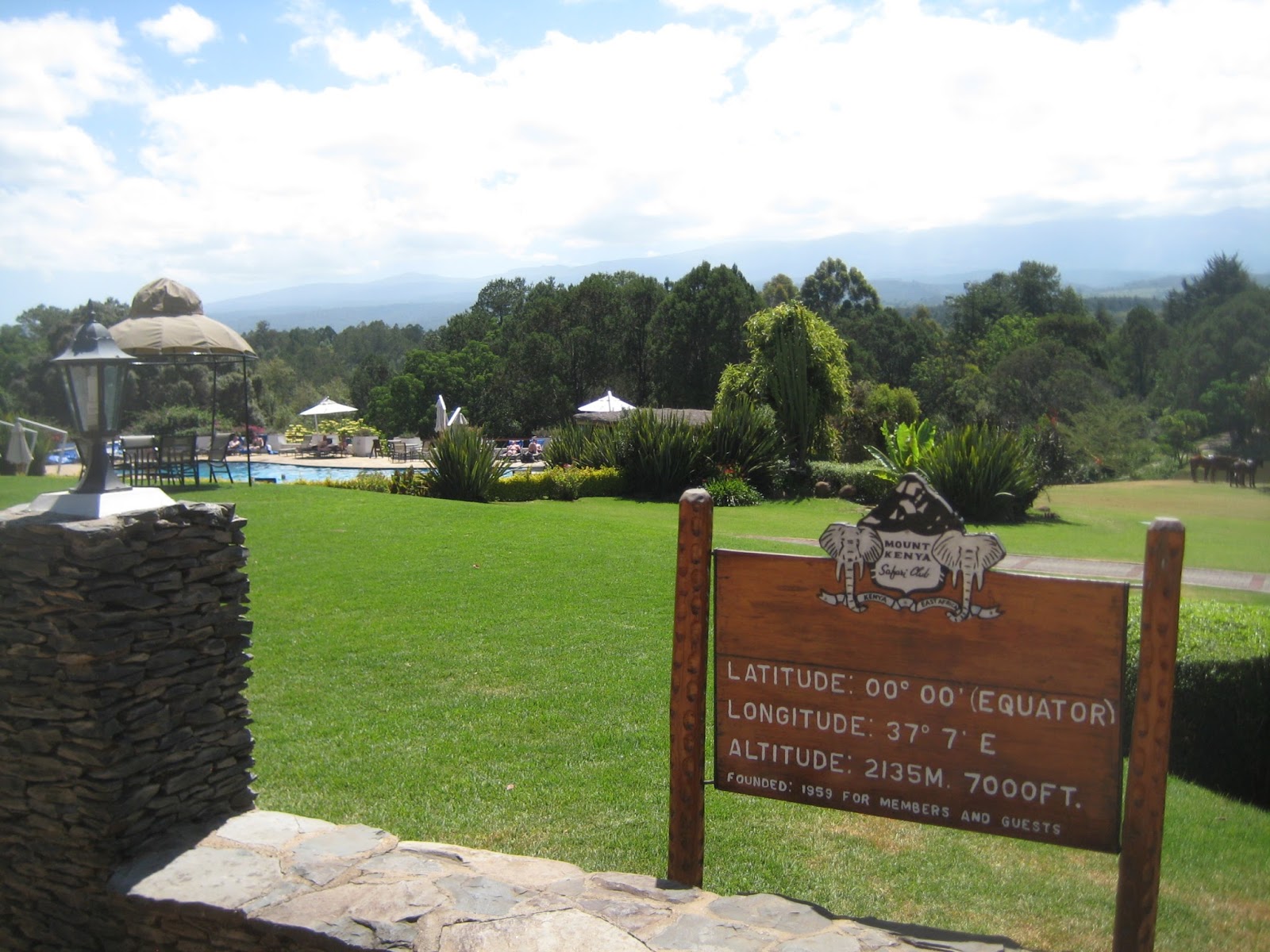
Following the descent, we were delivered by our guides to a freezing cold shower at Camel Camp, where our final night’s accommodation was in pastoral huts amongst roaming (you guessed it) camels. The following 18 hours replenished the depleted calorie stores and allowed us to soak up the luxuries of the bigger Nanyuki town. Pedicures for the girls, haircut and Irish pub for the boys, a late lunch at Trout Tree, and last but surely not least, the infamous brunch feast at the Mt. Kenya Safari Club. Three thousand shillings ($30), all you can eat buffet including fresh fruit, smoked salmon, multiple cheeses, grilled tomatoes, made-to-order omelettes, sweet breads, cappuccinos, all with a view of the mountain and the colorful hotel grounds. We stocked up with provisions at Nakumatt once more on our way out of town to ensure some comforts made it back to Chogoria.


--

On the walk home from work the following evening, a man stopped the car on his way out of the hospital’s housing compound. I was with one of the three new physicians from Michigan, in town for a one-month residency rotation. The man stuck his hand out the driver window. “My son – I just dropped him off. He will work at the hospital.” The former camp counselor (and chief resident) came out in me: “Excellent! We’ll take good care of him,” as I shook his hand. The new interns had arrived.

Medical Officers (MO) are those who have just graduated medical school. The MO Interns are those doing their one year of government-assigned rotating training. We have 10 just starting and roughly that many moving on, overlapping for three weeks. The new ones are energetic, ready to learn and serve. The old ones are drained and quick to draw up the call schedule for the new interns, suggesting starting them the day after they arrived in Chogoria. Fortunately, the rookies got a short introduction to the electronic medical record and a tour before being thrown in.

This week we have them out for an Advanced Cardiac Life Support (ACLS) class. This has proven popular with a couple other (higher-ranking, technically) MOs already at the hospital who have sat in on some sessions. Our two residents have been active in teaching the course alongside the Michigan physicians, one of the new young American missionary physicians, and me. Dr. Ritchie, the program director, put in great effort to schedule this course, coordinate the teaching schedule, and block time away for the new interns.

Anyone who has completed or worked in a residency program can tell you: blocking time off for interns can be a surprisingly high hurdle requiring crisis-level diplomacy. If new interns are out, that means old interns, or others, have to work. This ACLS training and the call coverage debate brought back fond memories of residency. These days for the course can be lighter, less stressful, and afford rare time for the intern class to build camaraderie all together. Internship and Residency can be trying on many levels, but the support of your classmates makes it tolerable.

Socially, the interns appear to be settling in well, having perfect attendance at the regular Friday night Pizza Night and a strong presence at the Sunday brunch hosted by the Michigan crew despite some of the interns being on call. There is nothing like free food to attract young physicians, no matter where you live.

Adapting to the role of attending, or “consultant,” has been enjoyable. In morning lectures, residents and interns get called on, while consultants offer advice based on experience. On rounds or in clinic, younger physicians practice medicine and deliver direct care, consultants offer suggestions, guide discussion, and occasionally dive deeper into topics questioned. The expanded opportunities for research and teaching are a welcome shift in daily duties.  

--

Living in the moment, enjoying your present, can be a challenge. Slowing down and just being here in Chogoria has taken an unpredictably difficult adjustment from my life in Austin. The daydreaming and living in the future got me here. So, I find it hard to believe that it is all bad as sometimes living in the present requires context. Keeping your vision or your inspiration in focus, I have realized, holds up the backdrop. The present is the main show.

Every time my housekeeper Catherine leaves my place, she thanks me and says goodbye. “Nice times,” she’ll say as she departs. Surely the meaning of that does not perfectly translate, but I cannot stop repeating that aloud to myself. “Nice times.” Nice times, indeed.

14 February 2016

The Chogoria Pattern

“We are out of vitamin K?...and streptomycin?” “Yes, but her family can go try to find it at a pharmacy in Nairobi.” The Intern called Mugao, our team’s nucleus, explained the stock-out. “You know, they say that in places without many facilities, God works harder.”


It is amazing how quickly life circumstances can change in two weeks. I was dropped at my flat on the PCEA Chogoria Hospital grounds just 12 days ago. It was mid-afternoon and I needed to plan for dinner. That requires cooking. Which requires utensils. And a stove. And food. All of which require shopping. You get the point.

Meticulous planning simply cannot prepare you for some things. Fortunately, my transition into life in Chogoria has been eased by the guidance and generosity of many key people. Leonard, the hospital staffer who does the work of three people, along with his staff that look after housing, helped fix leaks and ensure my kitchen was equipped with essentials like plates, bowls, and a coffee cup. The Webbers, a long-term missionary family with three of the cutest kids under the age of five, recently in from Uganda, welcomed me with dinner last weekend and a tense game of Ticket to Ride. The three international NGO staff have helped with critical local intel and sorting out a water filter. After multiple failed shopping attempts in Nairobi by others, Dr. Yulu (one of the residents) returned from Meru a hero yesterday with a modem to get me online at my flat! And finally, Mrs. Ritchie, our program director’s wife, the physical therapist, homeschool teacher, and mother of six, greeted me within an hour of arrival and helped me with everything from my first two dinners to a coffee pot to key introductions around town to a block of cheddar cheese.

My flat was renovated and painted in anticipation of my arrival. I am getting into the routine of buying fresh vegetables and fruits in the markets, finding zucchini, green peppers, tomatoes, mango, and apples, and cooking in the evenings. My new housekeeper came Friday and worked especially hard on the first deep clean. She is also helping me with washing and chopping vegetables in addition to laundry. She laughed at my lack of cleaning supplies, but is helping me provision to this end.


News of the drug stock-out came during rounds in the adult female medical ward. The day starts with breakfast and coffee on my back porch, enhanced by the daily sounds of over a hundred serenading secondary school girl voices coming from their four-story complex just over the hedge at 7:30 a.m.  Then, lecture at 8 a.m. with all Interns, clinical officers (CO), residents, and consultants. After my introduction on Day 1, we hit rounds. There are usually roughly 50 adult inpatients on the medicine service, and thus they have split into two teams, each led by a Medical Officer (MO) Intern. One team has a Physician Assistant from the States, Derek (father Webber), and Dr. Ikunda the CMO of the hospital. My team has the Burundian Dr. Boaz, one of the two Family Medicine residents, and me as the consultant (attending). Rounding on roughly 25 patients can take until 12:30 or 1 p.m., but rounding on the entire 56-patient service, as my team did last Saturday, can take longer despite the earlier start. Supposedly our service is a bit busier this week thanks to transfers from the public hospital down the road in Chuka where the nurses have been on strike since Monday.

Our service has patients with pulmonary tuberculosis (TB), AIDS, cryptococcal meningitis, extrapulmonary TB including meningitis and pericarditis, uncontrolled diabetes or hypertension, congestive heart failure, rheumatic heart disease, nephrotic syndrome, and substance abuse including a suicide attempt with pesticide. It feels like our team averages one or two deaths per day. This occurs without the flurry of a Code Blue, without commotion. The patient is physically gone from their bed the following morning.

Depending on the source you read, faith-based health providers (FBHPs) provide anywhere from 20% - 50% of healthcare in sub-Saharan Africa. PCEA Chogoria Hospital is a 300-bed hospital founded in 1922 founded by Scottish missionaries. It is a faith-based health facility which accepts the Kenyan National Health Insurance Fund (NHIF) for both in- and out-patient care, although the newly implemented outpatient coverage of $1 per month per patient does not even cover the costs of a chest X-ray ($5). The insurance fund pays roughly $22 per night in the hospital, but the patients pay out of pocket for specialized imaging like ultrasounds ($12), CT scans ($80 - $100) or medications not found in our pharmacy. Of course, the hospital accepts cash as well, and the very basic inpatient costs start at about $5 to cover linens and food, which is usually porridge. If the patient cannot pay their bill on discharge, they are kept in-house until they can, increasing their debt to the hospital.


The afternoons are usually devoted to clinic time or reserved for teaching sessions with the residents. More time will be spent in the outpatient setting in the coming weeks, now that we have a rhythm with the inpatient service. Traditionally though, these MOs on the inpatient medicine service only see their consultant roughly weekly, so they are used to the autonomy. Our Intern has been here at the hospital for almost a year and is strong, but we will exchange his class of interns for a new one in the next couple months, depending on government postings.  

The evening ends with cooking dinner, reading, and usually more nighttime singing coming from the secondary school.


Early in the week, one of our 60 year-old patients on the female ward began complaining of bilateral leg numbness and weakness just as her discharge was imminent. She was closest to the entrance and near the middle of the 32-bed female ward. The curtains to separate patients are typically not drawn. Dr. Boaz asked in Kiswahili if she had been up walking around at all and she said indeed she had. Her two neighbors on her row laughed out loud! The patient smiled. “Really, how far did you walk?,” he asked. Our patient, busted, pointed to the other side of the small ward. The other patients and our team all laughed along.


In medicine, we are taught to recognize patterns. And just as you get used to hearing all the stories that neatly fit into a particular diagnosis, someone says something that just does not sound right. Alarm bells are raised and the search for disease begins. After two weeks in Chogoria, my daily home and work routines, and the pattern of seeing incredibly ill patients, has all started to feel familiar. But one thing that is hard to simply accept is the vast difference between the pharmaceutical, imaging, funding, and health worker resources available here and those found in higher income countries needed to protect privacy and afford this community sufficient health care to thrive. For now, we will welcome the distraction of mid-rounds laughter along with the patient innocently lying about her walking effort.

24 December 2015

Alternative Gifts


During this holiday season, and as 2015 comes to a close, many are searching for meaningful “alternative” gifts to give. While my expertise is in healthcare, let me suggest a few reputable organizations that are doing good in my hometown and around the world.

Austin

Hope Medical Clinic offers healthcare to political refugees settled in Austin through the United Nations’ resettlement program. Unfortunately, their initial health coverage in the form of Medicaid lasts only eight months. Then, most of these refugees from Bhutan, Nepal, and Iraq are left uninsured, yet needing the same preventive, chronic, women’s, physical therapy, and dental care that we all need. Hope runs purely on volunteer support and is a way to help refugees here in our own backyard.

The Austin PrEP Access Project evaluates patients for Truvada, to be taken as Pre-Exposure Prophylaxis against HIV. High-risk patients are evaluated by volunteer medical providers and monitored through regular blood draws funded by private donors. PrEP has proven wildly successfulin lowering HIV incidence in San Francisco, saving lives and saving costs for the local community.

Global

Samaritan’s Purse through its World Medical Mission funds short-term medical missionaries in settings requesting assistance around the world. This faith-based organization places physicians, dentists, and other personnel and supplies into resource-poor settings. I will be teaching as volunteer faculty at PCEA Chogoria Hospital’s new Family Medicine residency program through Kabarak University from February through June 2016. Samaritan’s Purse’s World Medical Mission is assisting in coordinating my documentation, travel, and funding. Follow this link, search for my name, and be assured your tax-deductible funds will go to essentials such as travel, food, visas, and my Kenyan medical license.

Medic to Medic funds education for physicians in low-income areas. The US has 2.5 physicians per 1,000 people; Malawi has less than 0.1 physicians per 1,000. This is a sustainable way to fund the education of health workers where they are needed most. You could fund a medical student’s tuition and all supplies for just $750 per year. A close UK-based physician friend of mine is an organizational leader.

SEED Global Health is a public-private partnership with the US Peace Corps designed to place American physicians and nurses in medical/nursing school and residency training settings as faculty to assist in educating physicians, nurses, and clinical officers in low-income countries. Being a uniquely American NGO, this organization funds some educational debt repayment for each year of service. I will be teaching with SEED from July 2016 through June 2017.

In my opinion, these three global options all represent sustainable steps towards universal health coverage in some of the poorest areas on the globe. Please join me in supporting these servant organizations. Have a wonderful holiday season and a Happy New Year!