Showing posts with label Kenya. Show all posts

29 March 2016

Meeting Joe Black

The timeliness of watching Meet Joe Black early in the Easter week experienced here in Chogoria became apparent only late Sunday evening. Joe Black, played by a young frosty-tipped Brad Pitt, is perhaps the most attractive physical embodiment of Death ever created. He comes to get a taste of life the best way possible: alongside wealthy media mogul Bill Parrish (Anthony Hopkins) who is approaching the celebration of his 65th, and apparently last, year. A bit naïve to the daily jargon of life, Mr. Black at one point interrupts a board meeting of Parrish’s company when a board member mentions the certainty of death and taxes. “Death and taxes?” he asks, appearing confused and offended.

This week, the inevitability of physical death and the promise of life beyond death were juxtaposed in a way that leaves one pondering most proximately what awaits the deceased after life’s most final event.

--

The transition from old class of Medical Officer (MO) Interns to new class of MOIs came rapidly. Highlighted by wrapping up Advanced Cardiac Life Support (ACLS) training and a pot-luck goat roast funded by the hospital Wednesday night complete with speeches from much of the medical staff, the outgoing MOIs were done with their Intern year and headed out to work in various posts around the country. The new MOIs were now on their own, running each of the inpatient services and independently taking care of patients in the outpatient clinic.

The week after their ACLS training, a new MOI and one of our residents led a resuscitative success with a young poorly controlled hypertensive patient. She was shocked once and after some chest compressions and correcting her potassium level, she was alive. Depending on the etiology, resuscitations commonly end with death. And this past week saw a couple of attempts to revive extremely sick patients that ended poorly.


We showed up for rounds Thursday morning to find one of the two MOIs on our service missing. She had gone for a break after spending four of the early morning hours attempting to resuscitate, and eventually losing, two newly admitted patients. One transferred from another hospital down the road, another with severe lower gastrointestinal bleeding. Neither lived to be seen by our staff in the morning. The fellow MOI covered for his teammate. “She is not in a good emotional state, so she went to the house.” I was glad the MOI had made the wise decision to take a break to regroup after a rough morning.

She returned an hour later. No matter how she felt, a busy medical ward needed to be cared for and she was their primary physician. The last couple weeks our ward has had many interesting guests including the rare case of malaria, some brittle diabetics, an older man celebrating his discharge on the same day as his neighbor’s (“The two old men are going home!”), and the police officer who was visited on the ward by his four colleagues wielding a baton, an automatic rifle, and a newspaper.

Towards the end of rounds, the five-member family of our latest death appeared requesting to speak with the MOI. The head sister (nurse) in charge on the ward motioned for me to accompany her and the MOI in the discussion.

What do you say to someone who has had a family member recently pass away? What if you were the one entrusted with keeping them alive?

Many family members here in our area drop off their family members toward the end of life when they sense they cannot provide proper care for their loved one. We then do our best to control their pain and keep them comfortable, managing complications of advancing cancerous masses, bladder obstructions, severe systemic infections, and decreased oral intake. There is no Do-Not-Resuscitate (DNR) order here, so the attempts to revive, and their extent, are decided many times unilaterally by the MOI on call.

The MOI conducted the family meeting in a mixture of Kiswahili and English. She explained in detail the state in which the patient came in, the resuscitation attempt including who was present and what was achieved, and eventually when the elderly gentleman died. The nurse answered practical questions about morgue costs and how they could pay the hospital bill when they eventually took the patient for burial. The patient’s daughter knew death was imminent, she said. “I just didn’t think it would be this morning.” They thanked us and went to view their patriarch one last time.

The MOI admitted afterwards that she had never broken the news of a death to a family. So we debriefed, talking mostly about what she had done well and then what she could improve on for the next time. Remain objective, but show empathy. Discuss details in plain language, but only as much to be complete and adequately informative. Was my approach molded within the American system appropriate for this community? My MOI and I came to a few conclusions. Discussing death is never easy and always different depending on the circumstances and the family.


Then came Easter Sunday. We started with a service here at our campus Presbyterian 9 a.m. English service followed by a group lunch with a few missionary families. It was another beautiful day full of good food and an Easter egg hunt. But the resident was late.


He was called in to assist with the deteriorating patient we had dealt with for a week-and-half. She had just given birth to a healthy baby three weeks prior. Originally diagnosed 10 days ago as septic shock due to her low blood pressures and spiking fevers, a poor condition due to wide-spread infection, and treated with intravenous hydration and several powerful antibiotics, she was not improving. Further investigation with a bedside echocardiogram revealed a heart that was almost not contracting at all and a massive blood clot left by the stagnant blood in her left ventricle. Postpartum, or peripartum, cardiomyopathy was the new diagnosis and we prepared to transfer her to a higher level of care. Our hospital is usually the referral hospital for several smaller facilities nearby, but now we needed help. Before she could be transferred however, she passed away early Sunday afternoon. Her three-week-old infant laid wrapped on the nearby twin bed in the private room with grandmother sitting next to the baby.

--

No matter how inevitable, no matter the medical training in objectivity, death hurts. Seeing a death that leaves a healthy three-week-old without her mother begs the obvious question of “Why?”

Following the death of a patient, the discussion many times revolves around justifying both to ourselves and the family that we did “everything we could.” But had we in these cases? Did we have sufficient knowledge, medications, specialists, technology to “do everything?” No way. Had she given birth in my hometown of Austin, her chances of survival would have greatly increased. We could take comfort in knowing we did all that was possible within the constraints of our local system. But considering all the resources available on this planet, we had not truly “done everything.”

Life is precious and perhaps work in medicine offers a close-up yet lopsided view of just how quickly life can change.

Following the grand birthday celebration at the end of the movie and after Parrish has accepted his long, fulfilling life is over, Joe Black and Bill Parrish disappear over the bridge to his death. How peaceful. That romantic depiction of life and its end can occasionally be disrupted. Shaken by a lack of control and confronted with physical death, there must be something beyond that bridge, beyond the mother leaving her infant, that offers hope.

There is so much we can affect in modern medicine, but sometimes death comes. I choose to think Death came as Brad Pitt here in Chogoria. Perhaps I was just too blinded by the circumstances to even see him.


Sunset over Lake Victoria

08 March 2016

"Nice Times"

It was blazing hot. The ice in my drink made the cup sweat. I looked up across the horizon. Blue salt water ahead with the pool in my periphery. This was the life.

Just then, the front my head started to pound. I looked up at the pots of dinner being served on the Maasai-cloth-covered picnic table in our hut. I was wearing all the clothes in my bag and it was only the first night of our three-day climb up Mount Kenya. It was actually near freezing. And this city boy from Texas was ill prepared, clutching the one-liter thick plastic water bottle of recently boiled water. The views were incredible and the company of our six-trekker group assembled by the doctor from New Zealand made the hikes pass quickly. But the cold nighttime weather in a setting slightly outside of my comfort zone had me daydreaming.

I have been guilty of daydreaming before. I’ve even been called out by good friends when they have caught me distracted. So in this first month away, I have been extra careful to consciously ensure I’m present. “In the moment,” some call it. But I am not convinced that is always so easy, or absolutely necessary.


--

The excursion to Mt. Kenya was something I had considered prior to coming to Chogoria, so when the group effort had already been coordinated, I decided to take my first trip out of town. We traveled by matatu to Tumutumu to be hosted the night before by a young Pediatrician and her husband from the UK. They fueled us up with chapati and vegetables before the climb. The following morning, we had a proper cappuccino en route to stock up on snacks at the Nakumatt supermarket in Nanyuki before entering the park. It is a beautiful but challenging climb, with the second day requiring an 8-hour, 10-mile, steadily uphill trek. That day left me feeling lousy (perhaps with a bit of the 13,000-foot altitude contributing) at base camp, so I decided against summiting the next morning. Many say Mt. Kenya is tougher than Mt. Kilimanjaro and I now know why.

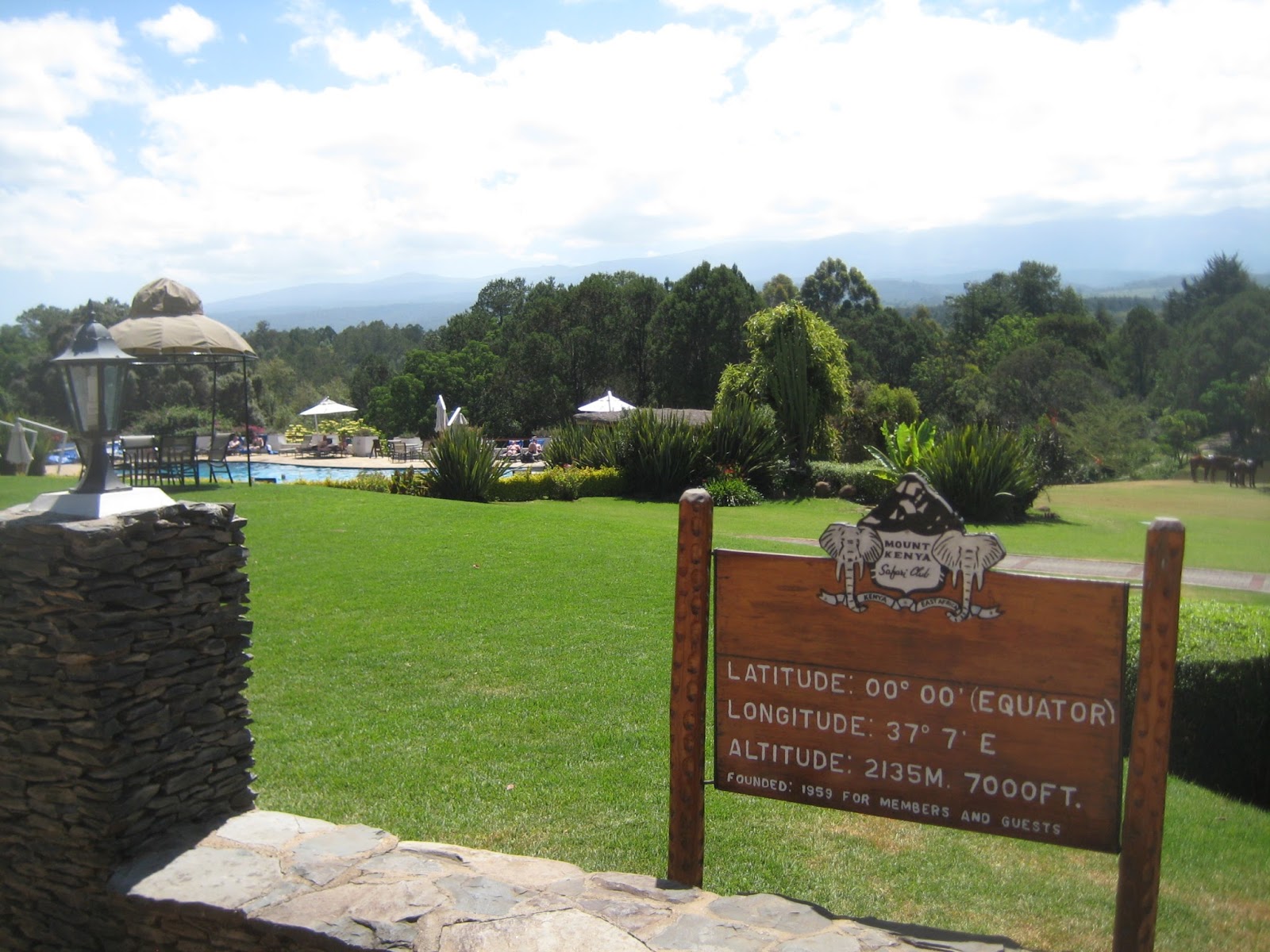
Following the descent, we were delivered by our guides to a freezing cold shower at Camel Camp, where our final night’s accommodation was in pastoral huts amongst roaming (you guessed it) camels. The following 18 hours replenished the depleted calorie stores and allowed us to soak up the luxuries of the bigger Nanyuki town. Pedicures for the girls, haircut and Irish pub for the boys, a late lunch at Trout Tree, and last but surely not least, the infamous brunch feast at the Mt. Kenya Safari Club. Three thousand shillings ($30), all you can eat buffet including fresh fruit, smoked salmon, multiple cheeses, grilled tomatoes, made-to-order omelettes, sweet breads, cappuccinos, all with a view of the mountain and the colorful hotel grounds. We stocked up with provisions at Nakumatt once more on our way out of town to ensure some comforts made it back to Chogoria.


--

On the walk home from work the following evening, a man stopped the car on his way out of the hospital’s housing compound. I was with one of the three new physicians from Michigan, in town for a one-month residency rotation. The man stuck his hand out the driver window. “My son – I just dropped him off. He will work at the hospital.” The former camp counselor (and chief resident) came out in me: “Excellent! We’ll take good care of him,” as I shook his hand. The new interns had arrived.

Medical Officers (MO) are those who have just graduated medical school. The MO Interns are those doing their one year of government-assigned rotating training. We have 10 just starting and roughly that many moving on, overlapping for three weeks. The new ones are energetic, ready to learn and serve. The old ones are drained and quick to draw up the call schedule for the new interns, suggesting starting them the day after they arrived in Chogoria. Fortunately, the rookies got a short introduction to the electronic medical record and a tour before being thrown in.

This week we have them out for an Advanced Cardiac Life Support (ACLS) class. This has proven popular with a couple other (higher-ranking, technically) MOs already at the hospital who have sat in on some sessions. Our two residents have been active in teaching the course alongside the Michigan physicians, one of the new young American missionary physicians, and me. Dr. Ritchie, the program director, put in great effort to schedule this course, coordinate the teaching schedule, and block time away for the new interns.

Anyone who has completed or worked in a residency program can tell you: blocking time off for interns can be a surprisingly high hurdle requiring crisis-level diplomacy. If new interns are out, that means old interns, or others, have to work. This ACLS training and the call coverage debate brought back fond memories of residency. These days for the course can be lighter, less stressful, and afford rare time for the intern class to build camaraderie all together. Internship and Residency can be trying on many levels, but the support of your classmates makes it tolerable.

Socially, the interns appear to be settling in well, having perfect attendance at the regular Friday night Pizza Night and a strong presence at the Sunday brunch hosted by the Michigan crew despite some of the interns being on call. There is nothing like free food to attract young physicians, no matter where you live.

Adapting to the role of attending, or “consultant,” has been enjoyable. In morning lectures, residents and interns get called on, while consultants offer advice based on experience. On rounds or in clinic, younger physicians practice medicine and deliver direct care, consultants offer suggestions, guide discussion, and occasionally dive deeper into topics questioned. The expanded opportunities for research and teaching are a welcome shift in daily duties.  

--

Living in the moment, enjoying your present, can be a challenge. Slowing down and just being here in Chogoria has taken an unpredictably difficult adjustment from my life in Austin. The daydreaming and living in the future got me here. So, I find it hard to believe that it is all bad as sometimes living in the present requires context. Keeping your vision or your inspiration in focus, I have realized, holds up the backdrop. The present is the main show.

Every time my housekeeper Catherine leaves my place, she thanks me and says goodbye. “Nice times,” she’ll say as she departs. Surely the meaning of that does not perfectly translate, but I cannot stop repeating that aloud to myself. “Nice times.” Nice times, indeed.

27 January 2011

Kenya: The Car Inspection

After a lot of Gatorade-powder-enhanced hydration, chicken masala, and chips masala last night, we were back on the horse this morning.

With Josh driving, we picked up Brenda's father ("Papa Joshua"), a clinical officer, who was to help with today's educational session at the clinic.  Today's trip down the Jomo Kenyatta Highway was a little different than the others.  Things were smooth sailing en route to Ahero from Kisumu until we noticed a lot of people walking along the side of the road.  We were asked to pull over by a few police officers standing on the side of the road, accompanied by a military officer and an "inspector."  This was a random crack-down on car inspection stickers, but the machine gun on the military man felt normal.  Josh is the perfect "Number One" to have here in Kenya, and I think the stickers usually aren't enforced, but today, the "2008" inspection sticker on our windshield was just a little too out-of-date for the Inspector and the Police.  Josh continues to refuse to pay bribes, which I would agree with (he knows best), so the Inspector took Josh's driver's license and KEYS to the truck and said he needed to go to Kisumu and pay for a new temporary sticker and then eventually get the truck "inspected," I guess.  No ticket.  No warning.  No opportunity to drive the truck back to the city and get the truck inspected properly.  

Word of the crack-down had spread, so no matatus were driving through this section of highway - I assume their stickers weren't even as up-to-date as ours, if they had one at all.  So the plan was for Josh to walk back towards Kisumu, in hopes of finding a matatu to give him a ride just up the road...and we (Mom, Papa Joshua, and me) would walk towards Ahero in hopes of finding the same.  That was the only option...

...Until Momma Bias got pissed.  Mom's been known to score a few free pizzas in her day, from Mr. Gatti's delivery drivers who showed up about 90 seconds past the time they promised:  "WHAT ARE YOU GONNA DO TO MAKE ME HAPPY?!"  Not pleased.  Well, apparently, the Inspector standing next to the Police officer with the giant baton and the military officer with the automatic weapon did not deter her.  She was NOT going to walk.  So, she approaches the inspector, "Look, Mom's tired and it's hot, something else can't be done here?"  I'm honestly not sure the exact quote, because I was standing back, paralyzed in shock.  So, they pull over one of the giant charter buses, Papa Joshua and the Inspector ask them to take us on, and they agree.

So, we make it to Ahero for about $1, and then broker a deal with a car for about $8.  This was still the expensive "mzungu price."  We are already haggling kings, so when the first truck said "1000 shillings" ($12), we said "forget it," and walked on.

At clinic, I saw about 7 patients.  Annette told me to bring all these anti-allergy eye drops (which aren't cheap) and I hadn't seen a single case yet, so I was beginning to wonder.  I saw 3 cases today, and I'm hoping the drops help.  It's amazing the irritation caused by the smoke and dust in the air.  

Brenda's 9-o'clock educational session began about 10:50 after Papa Joshua and we arrived.  They teach about preventing the spread of HIV to their unborn children among other basic public health teaching.  At the end of the session, they passed out toothbrushes and toothpaste, along with bed nets to all the mothers (about 24) in attendance.  Mom sat in the entire session while I was seeing patients, and her details are below.

The most uplifting experience of the trip came after we left clinic and headed to the community hospital in the neighboring village.  We found our mother - the one who delivered her baby in the village yesterday - sitting up, smiling, with a little more energy, breast-feeding her baby.  Baby clinically looked good.  We dropped off supplies for the mom - juice, flour, cooking oil, rice, beans, maize, infant formula, multivitamins with iron, soap, and a bed net - which Brenda helped us pick out and buy yesterday for about $30.  Your (and our) prayers were surely answered.

Her bill was going to be 2500 shillings (about $32), but we talked them down to a little less than 1000 shillings - $12.  $12.  $12 for a one-night hospital stay, 1 liter of IV fluids, a couple doses of metronidazole, dinner for the mother, and gloves and towels used for what took place in the "labour room."  Yes, we have an itemized receipt.  Money well spent.  One, or maybe you'd say two, patients helped.  Thank you for your prayers and contributions.

Being amongst extreme poverty in such a way gives me this conflicting feeling.  One instinct tells me that as soon as possible, I want to go to Disney World, or on a cruise, where every desire is catered to.  Everything is sparkling clean, and whatever you could imagine wanting is available.  Yet, we're also pulled to go home and conserve as much as possible - spending money only on essential priorities.  Conserve water.  Do without luxuries, take care of the basics, and contribute to those who truly are in NEED.

It also makes want to improve my Texas gentleman etiquette.  The southern hospitality courtesy.  There is a glaring lack of that here.  If I can walk ahead of you and cut you off, I do.  Women work and they work hard - planting and harvesting rice fields, walk to fetch water, take care of children and the household, and bring home the money.  This is true for most regions here.  Here, men ride shotgun.  

Mom's version:
Hello all!  I'm back and ready to report a day that was most interesting!  I've recovered from my sunburn and am well hydrated again.

Josh picked us up and as we were driving toward the clinic, we suddenly saw lots of people walking. Josh said, "Oh no, inspection".  And sure enough there were police and military men who pulled us over.  They asked for his license and noticed his inspection sticker was outdated.  He tried to reason with them but before I knew it, we were asked to get out of the truck, the keys and his license were taken away by the inspector and Josh was told to return to Kisumu to purchase a temporary sticker.  The truck would remain behind (although we later learned it was taken to the police station) and Josh would have to find his own way back and we would have to find our own way to the clinic. Fortunately, the social worker's father was going with us to the clinic and he was our interpreter.  I wasn't sure whether to cry or what.  I remained calm and went up to the inspector and said we were doctors and needed to get to the clinic and could Josh take us there and then return to Kisumu.  The inspector said "no" but when I made my plea that "Mama was old and couldn't walk", he must have felt a little bad cause he beckoned a large bus (like a Greyhound) and they took us all to Ahero (5 miles or so) for 100 shillings (about a $1).  Then we had to find another way to get from Ahero to Masara (about 10 miles).  A "nice" man offered to take us for 1000 shillings but Trav said, "no mzungu price--that's embarrassing" and started off as if we'd walk.  Thankfully, Joshua, our interpreter, found us a saloon car (a toyota 4 dr sedan) for 700 shillings and we were off arriving 1.5 hrs after we'd left. But seriously, what an adventure!  I had my hat, lots of water, and my sunscreen so was more prepared.

We arrived to a hearty welcome by Brenda, the Social Worker. She had invited 20 pregnant women to a training and her dad, a clinical officer (like a PA) was going to be the instructor for much of the time. It was to start at 9 but didn't get rolling til almost 11 (surprise--ha). Anyway, he began by having the women form a circle and have everyone introduce themselves (all in Kiswahili, of course) and tell their name, how far they were in pregnancy, marital status, # of children delivered and # alive as well as their village.  Many came from far away.  There were women pregnant for the lst time ranging to 11th time (this woman had 7 live children).  It was really a psychoeducation group where they could learn but also support each other and know that they weren't alone in their issues.  They learned about antenatal care, going to the clinic for testing for HIV, STDs, and malaria (most were afraid of learning about test results so didn't want to go), newborn care, breastfeeding and substitute feedings (diluting cows milk with water).  Joshua was quite entertaining and there was lots of laughter and the women loosened up and began to talk and ask questions.  He kept their attention and it truly appeared that they were learning many things for the lst time. By the time the training ended, there were 23 women, 6 babies and 2 community aide workers. At the end (after 4 hrs), they received insecticide-treated mosquito nets (bed nets from the Ministry of Health), toothpaste and toothbrushes (thanks to donations we brought), water and a special nutritious porridge.

Travis saw several patients during the training time and we left the clinic in yet another vehicle to head back to the hospital where the woman and baby we'd dropped off yday were recovering. I'm pleased to report that both mother and baby (a boy) looked 100% better. I'd feared they wouldn't live (thanks for all your prayers!).  People are tough here--you have to be.  It's truly survival of the fittest in it's rawest form.  Travis paid the bill at the hospital (about $12) and we delivered goods that Trav and the social worker had purchased yday. This included maize, flour, rice, stuff for porridge, baby clothes, formula (in case breastfeeding wasn't possible) and other stuff I can't remember.  Mom was most grateful and was going to rtn home today.

It's now about 4:45 and we're going to get back to the hotel to get ready for dinner with Dr. Allibhoy and his wife at 7:30. I'm really looking forward to this as the lunch I ate that his wife prepared for us earlier in our visit was quite good.  It will be interesting to see their lifestyle.

This is a place of many interesting contrasts. There are "car washes" (using dirty water) all along the roadway and yet everything else is so littered.  Many are starving in the villages yet there's a cell tower in the middle as many have cell phones.  I don't think I'll ever really understand but I do know that I'm incredibly grateful for all that we have available to us in the states.

I'll sign off for now.  Love to you all!!!!

-------

P.S. Josh is still at the police station.  Without the truck.

Asante sana!  Much love.

20 January 2011

Kenya: Clinic Day 1

Jambo!  Greetings from Kisumu.  We arrived on time to Nairobi smoothly two nights ago and were greeted at the airport by our host, Josh (essentially Dr. Bonyo's Number One here).  On our way out of the airport, a zebra darted across the road - Mom's first big surprise here in Africa.

The following morning we headed to Kisumu via a 7-hour Matatu ride.  The road was much smoother than I remembered in 2007 - still a 2-lane paved road, but with much fewer potholes.  We caught an amazing view of the great Rift Valley and arrived in Kisumu in time for a walk to the Safaricom store to buy a mobile phone and the Nakumatt to stock up on some South African wine and Bond 7 (whiskey).  Then, carrying 3 5-liter bottles of water and our new alcohol stores, we enjoyed Mom's first tuk-tuk ride home.  

We are staying at the Milimani Resort Hotel and are well taken care of by Jackie and Dan, among others.  Our dinner last night included chicken curry and chicken masala with potatoes (of course) and a fruit cup.  Mom's been surprisingly adventurous with her diet and socializing with everyone...  

After sleeping a full 10 hours and Josh jump-starting the battery to the Bonyo clinic truck, we headed out to the clinic today for our first day there.  We spent only about 4 hours out there due to the late afternoon rains, but we treated malaria, chronic cough, acute gastroenteritis, dehydration, and chronic severe osteoarthritis.  Jeanine and Mercy are the full-time nurses at the clinic, and have already taught me a good deal of tropical medicine and about their local practices.  For the last elderly patient with arthritis, we gave her a steroid injection in her right knee to alleviate some of her pain (sorry Dr. Bones, I stole some of your supply for this! - I owe you one).  Our last patient of the day, had to be referred to the hospital - the little boy appeared lethargic and dehydrated after just a day of gastroenteritis.  He highlighted the fact that even a mild gastroenteritis can be extremely complicated by malnutrition.  The boy and his grandmother were transported to the district hospital in Ahero via motorcycle - "we" (Dr. Bonyo's NGO) paid for the ride.

The motorcycle ride was a little less than the equivalent of $1.  Each clinic visit can cost anywhere between $1.50 - $3.00, depending on the age of the patient and the services provided.  These "user fees" are the subject of pretty significant controversy regarding the delivery of healthcare in developing areas.  Some argue they shouldn't be levied on those already in extreme poverty in order to meet basic humanitarian goals, yet others argue for "user fees" in order to preserve quality healthcare in their areas, properly allocate services to those in need, and pay for necessary medications.  The clinic regularly buys anti-malaria medications and antibiotics from the local wholesale pharmacy, and these are not free.  Obviously, the cost of medications is included in the total price of the clinic visit.

Transportation seems to have changed a lot as well.  There are many more motorcycles for transport in the rural areas out near the village of Masara, and again the roads seem much smoother.  Of course, matatus and tuk-tuks are still prevalent.  There are still the semi-trucks that are over-loaded and traveling at 5 mph that need to be passed by faster cars and matatus - we've already seen two over-turned semi-trucks with contents spilled all over the side of the road, yet luckily with no obvious injuries. 

Socially, we've been a bit held back by our jet lag, but we hope to get out for dinner tonight.  My limited Kiswahili skills have come back slowly, with my vocabulary consisting of only fragmented phrases:  Hello, yes, no, thank you, thank you very much, how are you?, good, very good, and please.  After further lessons with Josh and Tom (Dr. Bonyo's step-brother), I hope to expand my Kiswahili to longer sentences and perhaps learn to be able to floss some pick-up lines.  I'll keep you posted.

Josh has been an amazing host, introducing us around to his friends, his little nephews, and even his mother.  He showed us his digs and his mother's shop as well.  Not only do we owe him for the priceless hosting duties, but we also owe him 3000 shillings for not having enough cash for the matatu ride yesterday.  Woops.

Tomorrow, I plan to work with Dr. Allibhoy at the local Aga Khan Hospital.  I'm not sure what that will entail, but we plan to meet up with him tonight to learn more.  Mom hopes to meet up with any social services folks they have working at the hospital and with Brenda, the social worker for Dr. Bonyo's NGO here.

Since I can't capture all the thoughts and feelings of my travel companion (Mom), she wanted to say a little something:

Jambo (which means hello in Kiswahili).  Trav and I just finished our lst clinic day and it was quite amazing.  The clinic has 2 nurses and we saw about 4 patients today including 2 children who each had dehydration and gastroenteritis--both very common here.  We also saw an elderly lady who needed an cortisone injection in her knee which Travis did so well that the woman said he did a better job than the doctor she'd seen before.  How about that?  We unpacked both our extra bags of supplies - the coloring books and stickers have already been popular with the kids.  Our nurse Jeanine already asked for one of our pairs of reading glasses, and we anticipate using many more.  It is quite sobering to see the incredible poverty here.  Most people live in a hut made of cow dung and mud with a corrigated iron type roof which makes it very hot.  Water pumped from the village authorized pump is not drinkable but most people don't take the time to purify it and drink it anyway.  We saw countless people using ponds of very dirty water to wash clothes and bathe.  Most people get around on bikes or motorbikes and there are very poor roads with lots of pot holes and only 2 narrow lanes  plus they drive on the left side of the road.  This makes getting around quite exciting (we have a driver thankfully).  I'm feeling well and the food has been pretty good.  We're sleeping well and everyone is very welcoming.  Oriti (good bye) for now.  

Asante sana for all your support and prayers.  Please be in touch.  Much love from Kisumu. 

16 December 2010

Back to Kenya

One month from today, I'm headed back to Kenya.  And I'm taking Mom with me. 

I first traveled Kenya and sub-Saharan Africa, as part of the three-week SHARE Kenya medical mission during my fourth year of medical school.  I'd been interested in medicine in developing countries before starting medical school and this was my first such experience.  Now, I'm returning, structuring my trip as an elective rotation during my last year of residency.  We'll be there from January 17 through February 9, 2011.  I'll be working in a clinic in the village of Masara most of the time, with some time spent rotating in an Aga Khan Hospital in Kisumu.  I plan to train Mom to assist in the clinic amongst other social learning encounters around Kisumu.  We aim to go on a short safari through the Maasai Mara at the end of our time.  Afterwards, I'll head (solo) to Morocco for 10 days on my way home. 

Please see my mother's letter (below) to our friends and family, asking for support.  This year, I've only asked Santa for support for our trip, and I ask the same of you.  We look forward to hearing from y'all via Facebook or this blog.  Please be in touch, and keep our trip and Dr. Bonyo's Kenya Mission in your prayers.

From Mom:

Dear Family and Friends,


On January 17, 2011, Travis and I will be headed to Kisumu, Kenya for a 3.5-week medical mission trip. Travis has committed one of his elective rotations during his last year of residency to returning to the Mama Pilista Bonyo Memorial Health Centre in the village of Masara, roughly one hour from Kisumu. During this time, he will be the sole physician at this clinic working alongside its one full-time nurse. He will also spend some time rotating with one of the staff physicians at the Aga Khan Hospital in Kisumu. And I am beyond thrilled to be going with him to assist in any way possible.


We’re very excited to have this opportunity to serve together. I’ve always wanted to experience life as a missionary, so when Travis traveled to Kenya three years ago on his first true medical mission I mentioned how cool it would be for us to go on such a trip together in the future. When Travis decided to return to Kenya, Randolph suggested I go with him. I’ve booked my flight and have finished my series of 10 vaccines in preparation for the trip.


The purpose of this letter is to inform you of our trip and to ask for your support. It is going to cost us each about $3000 for our transportation, vaccines, and housing. We will also be purchasing supplies once in Kisumu, including medications, toothpaste, and multivitamins. We would appreciate any contributions you would feel comfortable making to defray these costs. Donations made directly to us will not be tax deductible, but even the smallest donation can provide life-saving medications and a fresh opportunity for those in extreme need. If you would prefer you could make tax deductible donations to Bonyo’s Kenya Mission, the non-profit organization that serves as the primary financial backer of this clinic.


Two other ways you might support our trip is with supplies and prayers. Travis says we will take with us multi-vitamins, tooth brushes, toothpaste, gently worn prescription and reading glasses, and gently worn children’s clothing; any of these you would give us we’ll take with us to Kenya. Or again, monetary donations we receive will go in part towards such supplies. Finally, we (and the people of Masara) would deeply appreciate your prayers, this January and beyond.


While we are in Kisumu, we will be sharing our trip with you as we can. Please find us on Facebook, or on Travis’s blog.


We hope you’ll start the New Year by supporting and following our trip with your prayers and your gifts.

In Love and Gratitude,

Cheryl Bias
1329 Braided Rope Dr.
Austin, TX 78727
Mobile 512.750.0845